
EXPLORE
LASIK in the Tampa Bay and St. Petersburg Areas
If you are tired of relying on glasses or contacts, LASIK eye surgery may give you the freedom you have been thinking about for years.
At Gulfcoast Eye Care, we provide LASIK eye surgery that Florida patients choose for clarity, convenience, and confidence. Our team of LASIK surgeons serves Tampa Bay, St. Petersburg, Pinellas Park, and Palm Harbor with advanced laser vision correction designed around your lifestyle.
See if LASIK or SMILE is right for you
LASIK SURGERY
What is LASIK Eye Surgery?
LASIK is a vision correction procedure that treats refractive errors, including myopia, hyperopia, and astigmatism.
Refractive errors occur when the shape of your eye prevents light from focusing clearly on the retina. That is why you may need glasses or contact lenses to see clearly.
By correcting how light focuses inside your eye, LASIK can reduce or even eliminate your need for glasses or contacts.
LASIK PROCEDURE
How Does LASIK Work?
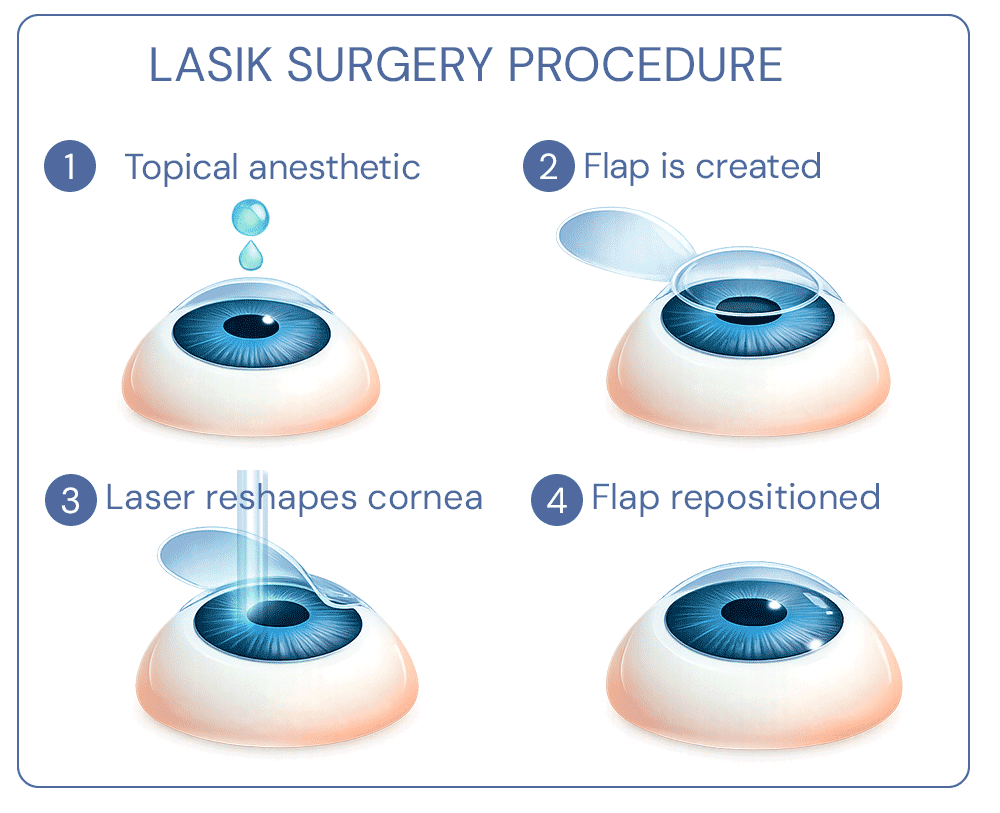
During the LASIK procedure, we gently reshape the front surface of the eye. This process is called corneal reshaping. By adjusting the curvature of the cornea, we improve how light enters the eye so images appear sharper and clearer.
Here is what typically happens:
- Your eyes are numbed with drops, so you remain comfortable.
- A thin flap is created in the cornea.
- An excimer laser precisely reshapes the underlying corneal tissue.
- The flap is placed back into position, where it naturally seals without stitches.
The excimer laser uses controlled pulses of cool ultraviolet light to reshape microscopic amounts of tissue precisely. The goal is to give you clearer vision without the daily maintenance of glasses or contacts.
Most patients are surprised at how quick laser eye surgery feels. The laser portion usually lasts only seconds per eye.
BLADELESS LASIK
All-Laser LASIK at Gulfcoast Eye Care
Many centers perform traditional LASIK using a mechanical blade device called a microkeratome to create the corneal flap.
At Gulfcoast Eye Care, Dr. Michael Manning performs all-laser LASIK instead. Using the VisuMax femtosecond laser, he creates the corneal flap with rapid, precise pulses of light rather than a blade.
This technology enables exceptional control and accuracy during the first step of the LASIK procedure. The femtosecond laser is programmed to create a flap at a highly specific depth and diameter based on your eye measurements. Greater precision during flap creation supports improved surgical accuracy and can contribute to more consistent visual outcomes.
Once the flap is created, an advanced excimer laser reshapes the cornea to correct refractive errors such as myopia and astigmatism. By reshaping the cornea with this level of precision, we improve how light focuses inside your eye.
Is LASIK Surgery Right for Me?
LASIK eye surgery has helped many patients throughout Tampa Bay improve their everyday lives. From professionals who spend long hours on screens to active adults who enjoy boating, golf, and beach days, laser vision correction can simplify daily routines and increase confidence.
You may be a candidate for LASIK if you:
- Are at least 18 years old
- Have healthy corneas
- Have had a stable glasses or contact lenses prescription for at least two years
- Want to reduce your dependence on glasses or contacts.
Being a good candidate for LASIK also depends on your overall eye health and the type of refractive errors you have. During your consultation, we perform detailed corneal measurements, evaluate your prescription, and discuss your lifestyle goals.

REFRACTIVE LENS EXCHANGE
What If I Am Not a Candidate for LASIK?
If you are not a candidate for LASIK, that does not mean you are out of options.
Some patients benefit more from PRK, which is another form of refractive surgery. Others with higher prescriptions or thinner corneas may be better suited for implantable contact lenses or a procedure that uses an intraocular lens. For patients over 40 or 50, Refractive Lens Exchange can address age-related vision changes and also prevent future cataract surgery by replacing the natural lens before cataracts develop.
We will explain your options clearly so you understand what each vision correction surgery involves and what results you can realistically expect.
The Benefits of LASIK in Florida
Freedom
Swim, boat, exercise, or travel with less worry. Many patients choose LASIK eye surgery because they want daily freedom from glasses or contacts. In Florida’s heat and humidity, contact lenses can dry out, and glasses can fog quickly. After laser vision correction, many patients enjoy clearer vision during outdoor activities and fewer limitations during everyday life.
Lifestyle
Your vision correction procedure should match your routine. Whether you are a working professional in Tampa, an active parent in Palm Harbor, or enjoying retirement in St. Petersburg, clear vision can make daily tasks easier. We focus on personalized eye care so your results support how you actually live.
Time Savings
Glasses and contact lenses require maintenance. Cleaning lenses, ordering contacts, and managing irritation all take time. LASIK simplifies your routine so mornings feel easier and travel feels lighter. Many patients say the convenience alone makes the decision worthwhile.
Cost Savings
When you add up the lifetime cost of glasses or contacts, the total may be higher than you expect. LASIK can reduce or eliminate those recurring expenses. Our savings calculator helps you estimate how laser eye surgery may compare financially over time.
Advanced Technology
Glasses and contact lenses require maintenance. Cleaning lenses, ordering contacts, and managing irritation all take time. LASIK simplifies your routine so mornings feel easier and travel feels lighter. Many patients say the convenience alone makes the decision worthwhile.
Experience
Dr. Michael Manning is Board Certified by the American Board of Ophthalmology and has performed thousands of vision correction surgery procedures. His experience in both LASIK and cataract surgery allows him to guide patients confidently toward the right solution for their stage of life.
LASIK RECOVERY
What to Expect From LASIK Recovery
After LASIK eye surgery, we provide detailed instructions and a recovery kit that includes prescribed eye drops and protective shields for sleeping during the first week.
In the first 12 to 24 hours, you may experience mild discomfort, light sensitivity, or a scratchy sensation. These symptoms are common and typically improve quickly with lubricating drops and over-the-counter pain relievers.
You will return the day after your procedure so we can confirm your eyes are healing properly. Most patients return to work within one to two days, depending on their comfort and job demands.

Enjoy Clear, Confident Vision with LASIK at Gulfcoast Optometry
LASIK eye surgery can help you experience everything your community has to offer with clearer vision and less dependence on glasses or contacts.
At Gulfcoast Eye Care, our experienced LASIK surgeons use state-of-the-art laser vision correction technology to help patients throughout St. Petersburg, Palm Harbor, and Pinellas Park feel confident about their vision correction procedure. From your first consultation to your final follow-up visit, we guide you through each step so you understand what happens next.
If you are ready to see how LASIK eye surgery, trusted by Florida patients, can improve your everyday life, take the next step.
Dr. Manning answers common Lasik Surgery Questions
What is the difference between traditional LASIK and All-Laser LASIK?
The difference between traditional LASIK and “All-Laser” or “Bladeless” LASIK is the method by which the LASIK flap is created. In “All-Laser LASIK”, a femtosecond laser device called a laser keratome, is used to create a corneal flap for LASIK surgery. This is a newer method to create a corneal flap than the traditional method of using a microkeratome, a mechanical device with a moving blade. There is no absolute agreement among all eye surgeons on the better choice for flap creation. Dr. Manning and many other surgeons believe that the computer-controlled laser provides superior precision as compared to that of a hand-held mechanical blade. This provides greater safety and control of flap size and thickness.
Will i be awake while the lasik procedure is being performed?
Yes, you will need to be awake in order to focus on a red blinking light within the microscope during the procedure. This helps to ensure that your treatment will be centered over your pupil. Patients sometimes inquire about general anesthesia, but it is not recommended for LASIK. Your eyes will be numbed for your LASIK procedure.
What happens if my eye moves during the procedure?
At Gulfcoast Eye Care, we utilize the most advanced lasers for laser vision correction. These lasers have sophisticated eye-tracking features that can detect and compensate for even tiny movements of the eye. In making these adjustments continually throughout your procedure, the laser beam is guided to remain centered precisely over the treatment area. In this way, the exact treatment is delivered precisely where it is intended to provide the highest level of comfort, precision, and safety.
Can I have both eyes treated at the same time?
Yes, most patients undergoing LASIK or PRK prefer to have both eyes treated on the same day for the sake of convenience. This is a decision that is best discussed between you and your doctor.
With PRK, the eye surgeon first removes the surface layer of cells by using a softening solution or the laser and then applies the laser to sculpt the underlying corneal tissue to achieve the desired correction. Upon completion, a bandage contact lens is placed for comfort and the surface layer then heals back in place over the next 72 hours. In LASIK, a flap with a hinge on one side is created in the cornea either with a microkeratome or a femtosecond laser. The flap is then lifted and the excimer laser is applied to sculpt the underlying corneal tissue to achieve the desired correction. The flap is then repositioned and reattaches with the natural hydrostatic forces of the cornea so that no stitches are needed.
Both procedures have minimal discomfort with the main sensations being a pressure-like sensation with the placement of the eyelid speculum and while the flap is being created with LASIK. After LASIK, there are generally a few hours or more where the eye has a scratchy, foreign-body sensation and sensitivity to light. In contrast, PRK generally has a period of 3-4 days during which this sensation may last. The visual recovery is generally more immediate with LASIK however both procedures generally achieve the same desired result.
Why do I need to stop wearing contact lenses prior to my LASIK preoperative testing?
Contact lenses can change the shape of your cornea, similar to how a watch band that you have been wearing can make an imprint on the skin of your wrist. If your eyes are measured too soon after taking out contacts, several of the tests could give inaccurate results that could affect your outcome.
If I am pregnant or nursing, how long must I wait to have LASIK?
You must wait a minimum of six weeks after you are no longer pregnant or breastfeeding. Even then, we must assess that some of the changes or fluctuations that can occur with your cornea during pregnancy are no longer taking place so that you may receive your best possible result.
If I have had a previous eye injury, can I still have Laser Vision Correction?
A complete eye examination is necessary to determine whether you may still be a good candidate despite a prior eye injury.
If I have “lazy eye” or amblyopia, can I still have Laser Vision Correction?
Amblyopia, sometimes called “lazy eye”, is a condition of incomplete visual development in a person with otherwise healthy eyes. If you have amblyopia, Laser Vision Correction generally cannot improve your vision to a level that is better than your best-corrected vision with your corrective lenses. To establish realistic expectations of what Laser Vision Correction may achieve in your amblyopic eye, you should discuss this further with your eye doctor.
Is LASIK Safe?
LASIK is FDA approved and is widely regarded as a safe procedure with a low rate of complications.4 Some of the most common side effects associated with LASIK, such as blurry vision or dry eyes, are usually temporary and will typically go away soon after surgery.5 According to the American Refractive Surgery Council, surgical complications occur in fewer than 1% of LASIK surgeries.6
What are the potential risks of LASIK?
All surgical procedures carry some risk of complications or side effects. Potential risks of LASIK include overcorrection, undercorrection, dry eyes, and temporary double vision or halos.7 The team at Gulfcoast Eye Care has a track record of success and prioritizes patient safety at all times.
How much does LASIK Cost?
LASIK at Gulfcoast Eye Care is fully customized for each patient. The price of a LASIK procedure can vary depending on your individual vision needs, and will be discussed during a consultation appointment.
Is LASIK covered by insurance?
Generally, insurance companies view LASIK as an elective procedure and therefore do not cover the cost of LASIK. Very few insurance companies offer LASIK discounting with participating providers. We offer special LASIK savings promotions as well as great financing options.
Will I have to wear an eye patch after LASIK?
No. You will be given post-LASIK instructions that include some eye shields to wear at night or when sleeping immediately following your LASIK procedure. The purpose of these is to prevent you from rubbing your eyes.
How soon after LASIK surgery can I drive?
You should avoid driving immediately after surgery while you are still under the influence of relaxing medications. You may resume driving as soon as you feel comfortable with your vision. The majority of patients are able to drive on their own on the day following LASIK. Following PRK, it may take 4-5 days to feel comfortable that your vision is clear enough for driving.
Can I scuba dive following Laser Vision Correction?
Yes, you may scuba dive as soon one week following your procedure once your LASIK surgeon clears you.
When can I wear eye makeup after surgery?
It is best to wait one week prior to wearing eye makeup. To decrease your risk of infection, it is a good idea to purchase new mascara.
How do I proceed? What is my next step toward LASIK?
Please contact Gulfcoast Eye Care today at 727-895-2020 to speak with a surgical counselor. Our counselors are available Monday through Friday 8:00AM – 5:00PM. We would be happy to schedule an Eye Analysis for you. This will help us identify the procedure for which you are the best candidate.